 You are here

![[Class 7] Bījgaṇita by Bhāskarāchārya (1150 CE) mentions this problem - The "Magic Formula" for Linear Equations](https://cdn.teachoo.com/62ebe40c-aae1-44a9-942d-2975ae703417/slide130.jpg)
The "Magic Formula" for Linear Equations
Last updated at February 10, 2026 by Teachoo
Transcript
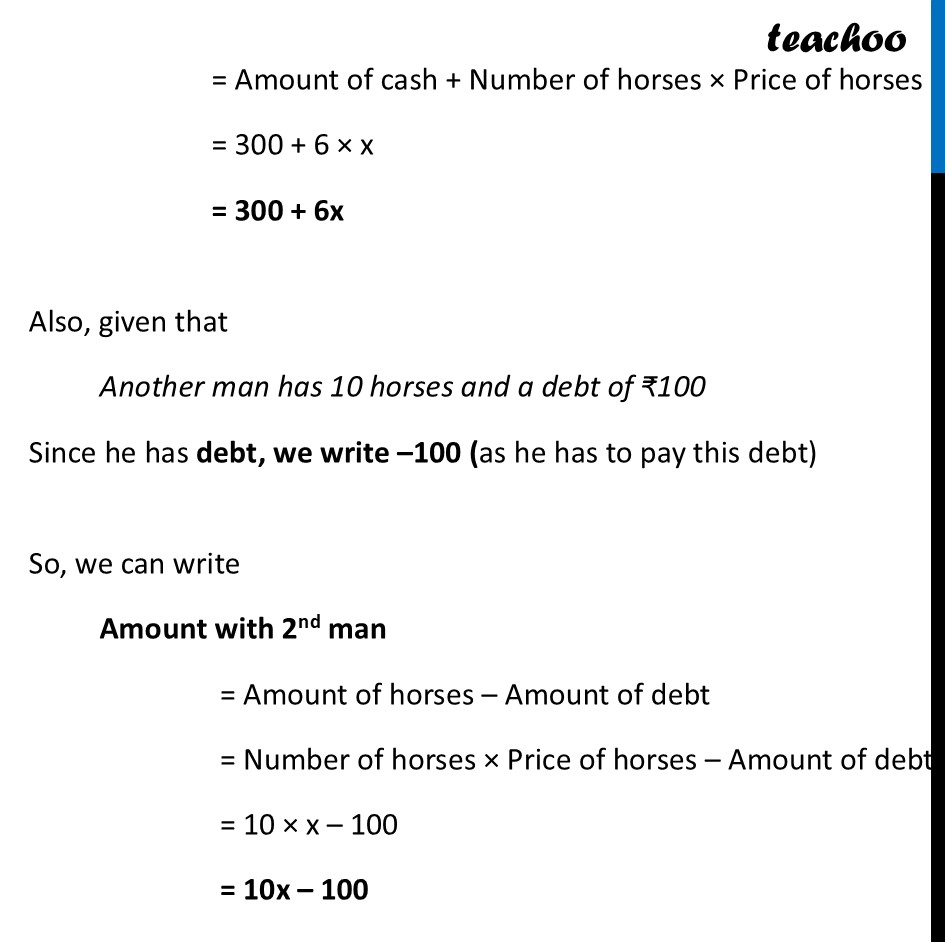
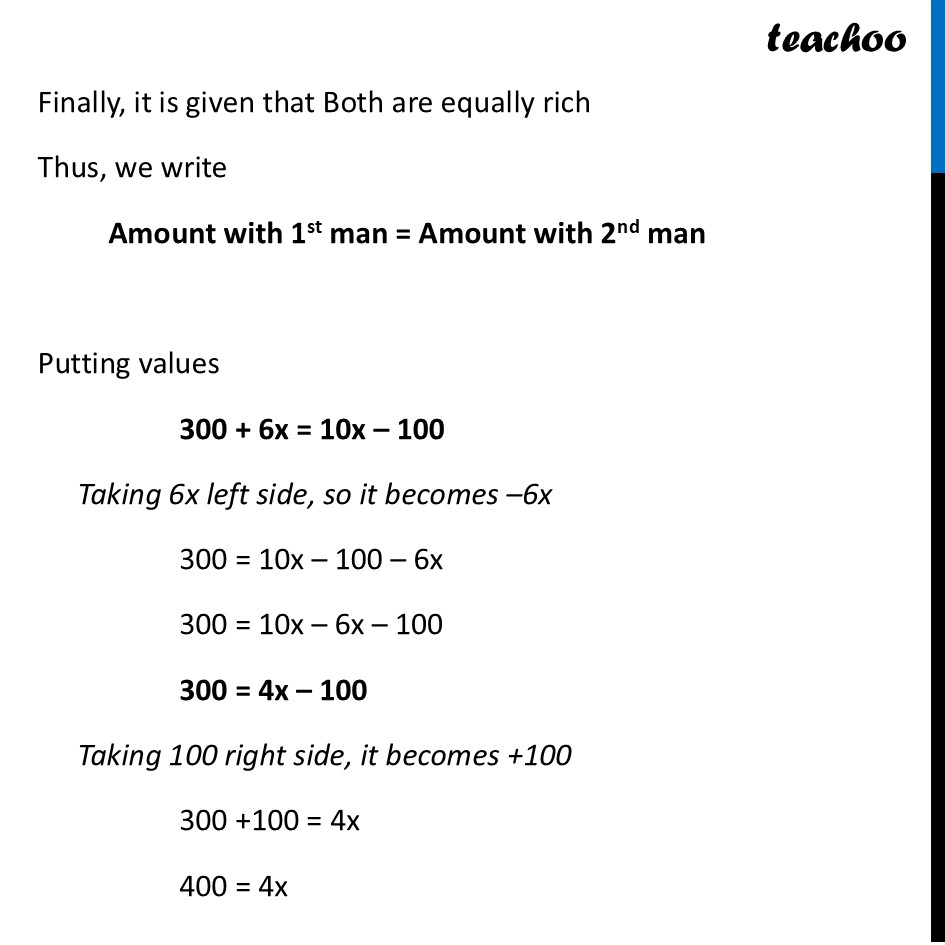
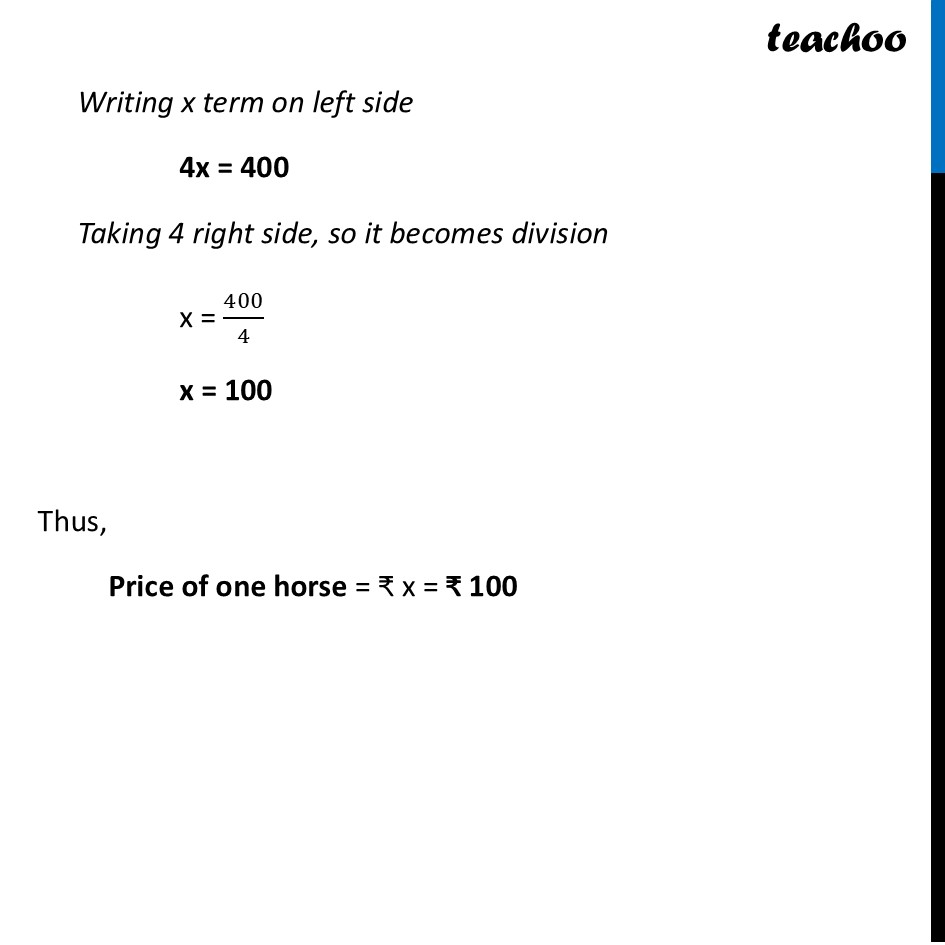
Example 16 Bījgaṇita by Bhāskarāchārya (1150 CE) mentions this problem. One man has ₹300 rupees and 6 horses. Another man has 10 horses and a debt of ₹100. If they are equally rich and the price of each horse is the same, tell me the price of one horse. Since the price of horse is the same Let Price of one horse = ₹ x Now, given that One man has ₹300 rupees and 6 horses. So, we can write Amount with 1st man = Amount of cash + Amount of horses = Amount of cash + Number of horses × Price of horses = 300 + 6 × x = 300 + 6x Also, given that Another man has 10 horses and a debt of ₹100 Since he has debt, we write –100 (as he has to pay this debt) So, we can write Amount with 2nd man = Amount of horses – Amount of debt = Number of horses × Price of horses – Amount of debt = 10 × x – 100 = 10x – 100 Finally, it is given that Both are equally rich Thus, we write Amount with 1st man = Amount with 2nd man Putting values 300 + 6x = 10x – 100 Taking 6x left side, so it becomes –6x 300 = 10x – 100 – 6x 300 = 10x – 6x – 100 300 = 4x – 100 Taking 100 right side, it becomes +100 300 +100 = 4x 400 = 4x Writing x term on left side 4x = 400 Taking 4 right side, so it becomes division x = 400/4 x = 100 Thus, Price of one horse = ₹ x = ₹ 100
